

Last Updated on May 10, 2026
Window frames are built to last decades. When one starts to bow, twist, or stick in its opening, most homeowners assume it is just old age. In reality, frame distortion almost always traces back to one or more specific, identifiable causes. Knowing what they are changes how you respond.
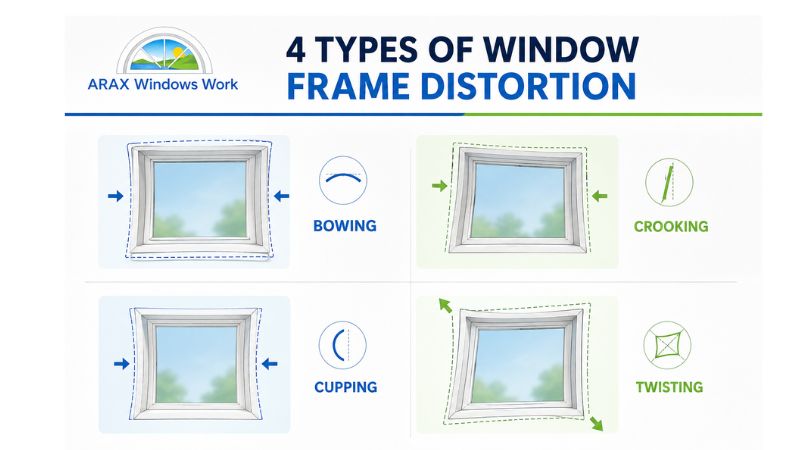
The Four Types of Frame Distortion
Before getting into causes, it helps to name the different ways a frame can distort, because they do not all look the same and they do not all point to the same root problem.
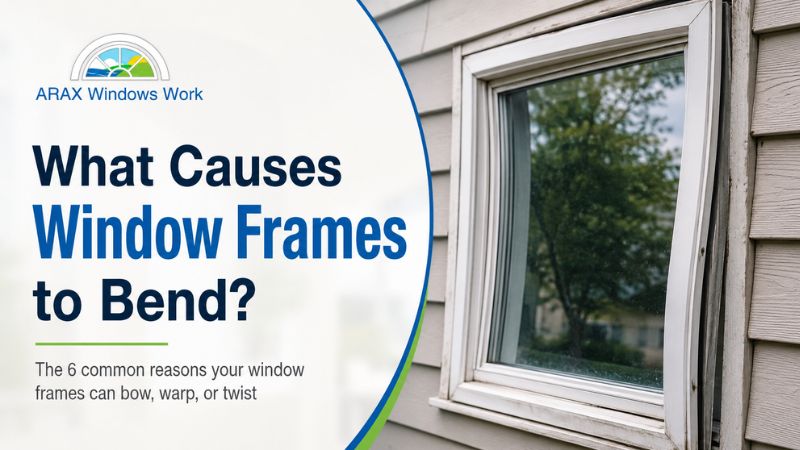
- Bowing is the most common. The face of the frame curves outward or inward, and you can often see it just by looking at the window from a few feet away. A bowed frame usually means the center of the frame has moved while the corners stayed relatively fixed.
- Crooking happens along the edge of the frame rather than the face. When a frame is crooked, the sash tends to bind on one side when you try to open or close it.
- Cupping is when one edge of the frame curls inward or outward, creating a slight cup shape. On wood frames, this almost always points to uneven moisture exposure where one face of the wood got wet repeatedly while the other stayed dry.
- Twisting is the most severe form. When a frame twists, the four corners of the window no longer sit in the same plane. Locks will not engage properly, gaps appear at the corners, and the glass itself can end up under uneven stress.
Understanding which type of distortion you are dealing with is the first step toward diagnosing the actual cause.
The Six Root Causes of Window Frame Distortion
Moisture Absorption and Uneven Swelling
Wood is hygroscopic, meaning it constantly exchanges moisture with the surrounding air. When humidity rises, wood fibers absorb water and swell. When conditions dry out, the wood releases moisture and contracts. This sounds straightforward until you consider that the process almost never happens evenly.
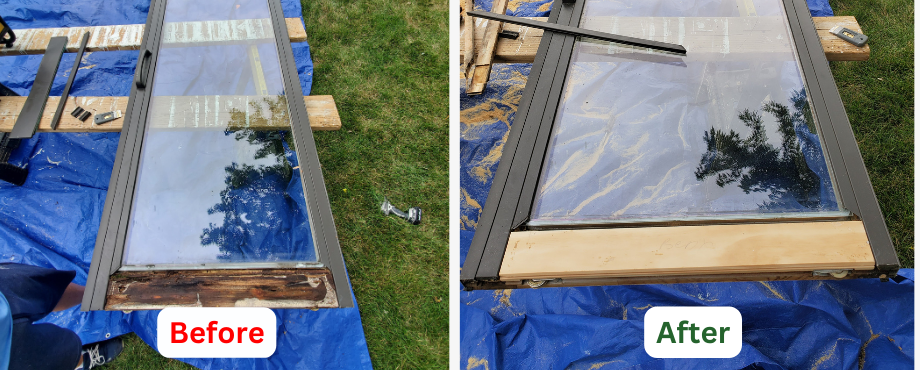
The exterior face of a wood frame might get soaked during a rainstorm while the interior face stays dry. The exterior face swells, but the interior does not. This creates internal stress across the thickness of the frame, and the wood responds by bending toward the drier side. Do this through enough seasons and the distortion becomes permanent. The wood fibers on the wetter side break down structurally and no amount of drying restores the original shape. If you have wood frames showing early signs of this, read our guide on whether wooden window frames can be repaired before the damage progresses further.
Thermal Expansion Under Heat Load
Vinyl frames warp for a fundamentally different reason than wood frames. PVC, which is the base material in virtually all vinyl windows, is a thermoplastic that softens when heated and hardens when cooled. Every warm day, the frame expands. Every cool night, it contracts. Over years, this cycle accumulates stress in the material.
The threshold that matters is roughly 140°F surface temperature. On a south-facing wall during a hot summer afternoon, dark-colored vinyl frames can easily reach this point. At that temperature, lower-grade vinyl loses enough rigidity that the constant pressure from the locking mechanisms at the top and bottom of the sash, pressure that was designed for a rigid structure, pulls the softened material inward. When the vinyl hardens overnight, it holds its new distorted shape.
140°F threshold where low-grade vinyl begins to lose dimensional stability
Dark-colored vinyl absorbs heat at a significantly higher rate than white or light frames. This is not a reason to avoid dark frames. It is a reason why the quality of the vinyl formulation matters more when you choose them. Premium vinyl includes thermal stabilizers and UV inhibitors in the compound, plus internal steel or aluminum inserts that maintain rigidity even under high heat loads.
Poor Installation Technique
Installation problems often take two to three years to fully manifest, which makes them easy to misattribute. A window that was installed badly can look and operate fine initially, then develop visible distortion as the house moves and the frame absorbs its environment.
The most common installation cause is over-fastening. When screws are driven too tightly through the frame into the rough opening, they create fixed stress points. As the material naturally expands and contracts with temperature, those points restrict movement locally while allowing it elsewhere, and the frame warps between them.
The opposite failure is under-shimming: leaving the frame loose with inadequate shimming to hold it square in the opening. A frame with no proper lateral support will rack under its own weight over time, conforming to whatever imperfect geometry it settles into.
Vinyl windows in particular require deliberate clearance gaps between the frame and the rough opening framing, which are small allowances for thermal movement. If those gaps are not included, every hot day becomes a force pushing against fixed constraints, and warping is the result.
Structural Movement in the Building
This cause gets misdiagnosed more than any other. When the structure surrounding a window opening shifts due to foundation settlement, beam deflection, or dimensional lumber drying and shrinking over years, the rough opening changes shape. The frame inside it gets squeezed and forced out of square.
A window frame is manufactured to sit in a rectangular opening. When that opening becomes a parallelogram, the frame has no choice but to distort to accommodate it. The distortion is not a window failure. It is the window recording a building failure.
The diagnostic tell: if multiple windows on the same wall, or at the same floor level, are all showing similar distortion patterns simultaneously, the cause is almost certainly structural rather than the windows themselves. Other signs include doors in the same area that have become sticky, diagonal cracks in drywall above window or door openings, and gaps between interior trim and the wall surface.
Replacing windows in a structure with an unresolved settling issue is temporary. The new windows will eventually show the same distortion for the same reason.
Prolonged UV Exposure and Surface Degradation
Ultraviolet radiation breaks down window frame materials independently of the thermal cycling issue. UV exposure degrades the polymer chains in vinyl, making the material progressively more brittle and less dimensionally stable. It attacks the surface of painted wood frames, accelerating the moisture infiltration cycle described above.
Windows on south-facing walls consistently show age-related problems earlier than north-facing windows, and the reason is entirely about cumulative UV and heat exposure. This pattern is useful diagnostically: a home where south-facing windows have significantly more distortion than identical windows on the north wall is showing UV-driven degradation, not a manufacturing or installation defect.
Reflective surfaces compound this. A light-colored concrete patio or pale exterior wall directly below or opposite a window reflects meaningful additional heat and UV back onto the frame, effectively increasing the exposure rate beyond what simple orientation would suggest.
Material Quality and Manufacturing Specification
Some frames bend because the material they were made from was never going to perform over a 20-year lifespan in a real climate. This is worth stating plainly: the window industry spans an enormous quality range, and the differences are not visible at purchase time.
A vinyl frame made from virgin PVC compound with proper thermal stabilizers, wall thickness at or above industry minimums, and internal reinforcement is a fundamentally different product from one made using recycled regrind vinyl with thin walls and no internal support, even though they may look identical from the outside at installation.
Wood frames that were not properly kiln-dried before manufacturing carry uneven internal moisture levels. As that moisture eventually equalizes with the environment over the first few years of the window’s life, the wood distorts. There is no way for the buyer to detect this at the time of purchase, and problems typically appear two to four years after installation.
Composite frames, which blend wood fiber with polymer resins, sit between wood and vinyl in moisture resistance and between vinyl and fiberglass in thermal stability. Both fiberglass and composite carry higher price points for concrete structural reasons that manifest over decades of performance.
What Warped Frames Actually Cost You
- Energy Loss: A bowed or twisted frame creates gaps between the sash and frame. Those gaps are air leaks. Your heating and cooling system runs longer than necessary to compensate, and the difference shows up directly on your utility bills every month.
- Security Weakness: A frame that no longer closes to its designed geometry often cannot fully engage its locking hardware. A window lock that does not fully seat is not providing the resistance it was engineered to provide, which creates a meaningful vulnerability in any room.
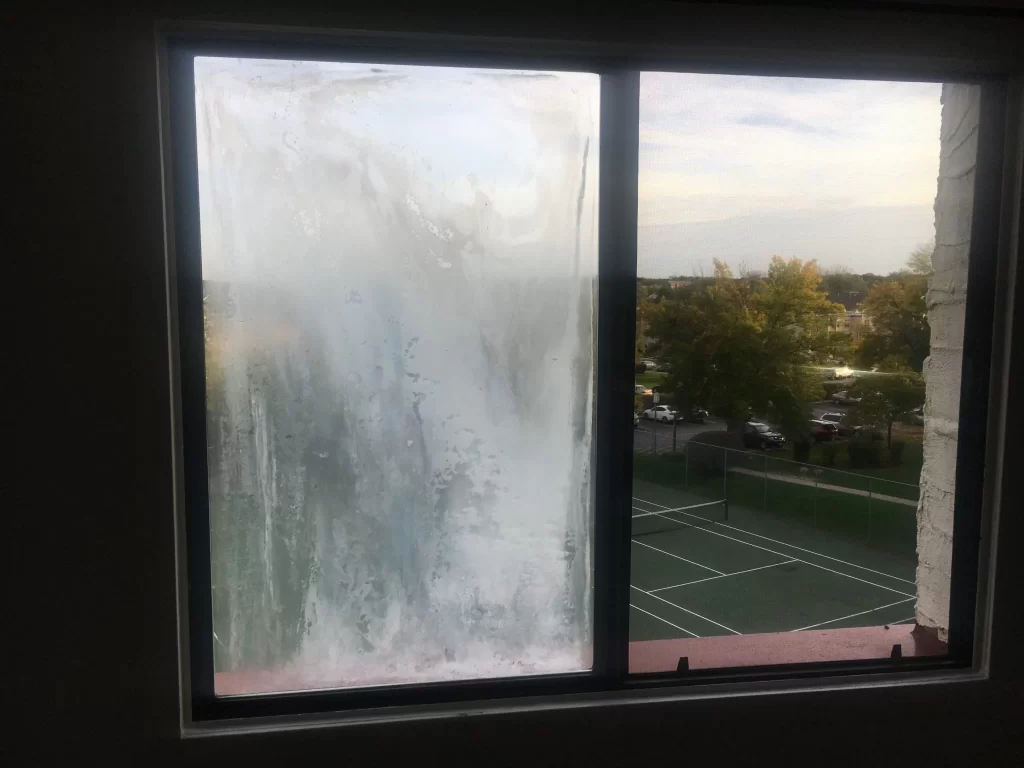
- Glass Stress and Seal Failure: Insulated glass units are designed to flex slightly within a square frame. When that frame distorts, the stress distribution on the sealed glass assembly changes, accelerating the seal failures that cause the foggy-pane appearance most homeowners notice first.
Repair vs. Replacement: What Works?
Temporary Repair
Replacing weatherstripping improves the seal for minor warping. Adding or adjusting shims can sometimes stop the progression of distortion in a vinyl frame if caught very early. A wood frame that warped from moisture can occasionally be stabilized if fully dried and refinished before rot establishes itself.
These are holding measures, not solutions. A frame that has permanently distorted cannot be pulled back to its original geometry with any practical method.
Full Replacement (Recommended)
When a frame has genuinely warped, meaning the material itself has yielded and hardened in its new shape, replacement is the correct response. For a deeper look at how to make that call, our article on when to repair instead of replace your windows walks through the key decision points. Manufacturers build to tight tolerances because even a few millimeters of distortion affects how the sash seals and operates. Modern high-quality frames are substantially more resistant to all the causes described here than products from 15 to 20 years ago.
Frame Materials Compared
| Material | Moisture Resistance | Thermal Stability | Longevity | Notes |
|---|---|---|---|---|
| Wood | Requires consistent maintenance; highly vulnerable to moisture without intact paint | Moderate | Moderate | Prone to swelling, rot, and warping if not properly sealed |
| Standard Vinyl | Good | Low to Moderate | Moderate | Quality varies; low-grade vinyl can warp under sustained heat exposure |
| Reinforced Vinyl | Good | Good | High | Steel or aluminum internal inserts improve rigidity and performance |
| Composite | Excellent | Good | High | Wood fiber + polymer blend; balanced stability and moisture resistance |
| Fiberglass | Excellent | Excellent | Very High | Best dimensional stability; expands similar to glass; no moisture absorption |
Distortion Has a Cause. Find It Before You Fix It.
Understanding why window frames bend comes down to a short, specific list: moisture damage in wood, thermal stress in vinyl, installation errors, structural movement in the surrounding building, UV degradation, and material quality. Each one has a clear physical mechanism, and each one points toward a specific response.
The homeowner who replaces a bowing wood frame without addressing the failed paint and drainage situation causing the moisture infiltration will have the same problem in the new frame within a few years. The one who replaces windows in a house with an active foundation settlement issue will see the new frames distort for the same structural reason.
Addressing the actual cause rather than the visible symptom is the only approach that produces a result you will not have to revisit. That starts with correct diagnosis, and correct diagnosis starts with understanding exactly what each type of distortion is telling you.
Think Your Frames Are Telling You Something?
As a trusted window repair specialist in Buffalo Grove, Arax Window Works specializes in diagnosing exactly what is causing your frames to fail and restoring them the right way. We do not guess and we do not replace what does not need replacing. If you are seeing bowing, sticking, or drafts that were not there before, that distortion is pointing to something specific and we can tell you exactly what it is. Call Now: (815) 230-1890
FAQs
Q: How do I know if my window frame is warped or if my wall has shifted?
Check multiple windows on the same wall. If only one window is distorted, the frame itself is likely the issue. If two or more windows on the same wall are showing similar problems, structural movement in the wall or foundation is the more likely cause.
Q: Why is my window bowing in the middle?
A window bowing in the middle almost always means the frame material has lost its rigidity at the center span while the corners remain relatively fixed. In vinyl frames, this happens when sustained heat softens the material and the locking pressure from the top and bottom of the sash pulls the center inward. Once the vinyl cools, it hardens in that bowed position. In wood frames, bowing in the middle typically points to uneven moisture absorption where the center of the frame absorbed water repeatedly while drying unevenly, causing the fibers to permanently deform toward the drier side. A frame that bows in the middle is no longer sealing correctly and will allow air to pass through even when the window appears closed.
Q: How much does it cost to rebuild a window frame?
Rebuilding a window frame in the Chicago area typically costs between $300 and $700 per window, depending on the size of the frame, the material being used, and the condition of the surrounding rough opening. Wood frame rebuilds on the lower end of that range involve epoxy fill and refinishing of salvageable sections. A full frame replacement using new vinyl, composite, or fiberglass runs higher, particularly if the surrounding wall framing or sill needs repair at the same time.
Q: What does a stress crack in a window look like?
A stress crack in a window starts at the edge of the glass, not the center, and runs inward at an angle rather than spidering outward the way an impact crack does. It is typically a single clean line with no branching. Stress cracks develop when the glass is under uneven pressure, most often from a warped or distorted frame squeezing the glass unit unevenly, from extreme temperature differences between the center of the glass and its edges, or from improper installation that left the frame under tension. Unlike impact cracks, stress cracks often appear with no obvious cause and can grow slowly over days or weeks.
Q: Do vinyl windows bend more than wood windows?
They bend for different reasons. Wood bends from moisture. Vinyl bends from sustained heat. In climates with hot summers and south-facing exposures, lower-grade vinyl is actually more prone to visible warping than well-maintained wood.
Q: What is the most warp-resistant window frame material?
Fiberglass. It expands and contracts at nearly the same rate as glass, does not absorb moisture, and holds its shape across a wider temperature range than either wood or vinyl. Composite frames are a close second.
Q: Does frame color affect warping?
Yes, particularly for vinyl. Dark-colored vinyl frames absorb significantly more heat than white or light frames, which raises the surface temperature and increases the risk of thermal distortion. It is not a reason to avoid dark frames, but it does mean material quality matters more when you choose them.