


Last Updated on August 19, 2026
If one room in your house always feels colder than the rest, or your furnace runs nonstop through the winter, a drafty window is often the reason. According to the U.S. Department of Energy, heat gain and loss through windows account for 25 to 30 percent of the energy homes use on heating and cooling, and sealing those leaks can cut annual energy costs by 5 to 30 percent. In a lot of the older homes we work on throughout the Chicago suburbs, that leak is a single window nobody’s gotten around to checking.
You don’t need special equipment to find one. Most air leaks can be located with things you already have at home. Here are five tests you can run this weekend, in order from fastest to most precise, along with what to do if a window fails.
1. Do a Visual Inspection
Start outside. Walk around your house and look closely at the caulking where each window frame meets the siding or brick. Caulk that has cracked, pulled away, or crumbled leaves a gap for outside air to pass through, and it’s one of the most common sources of window drafts.
If you have older single-pane windows, check the glazing putty that holds the glass in the sash. Dried or missing putty lets air move around the edge of the glass. We see this constantly on the wood-frame windows common in pre-1960s homes across Cary, Naperville, and the surrounding suburbs.
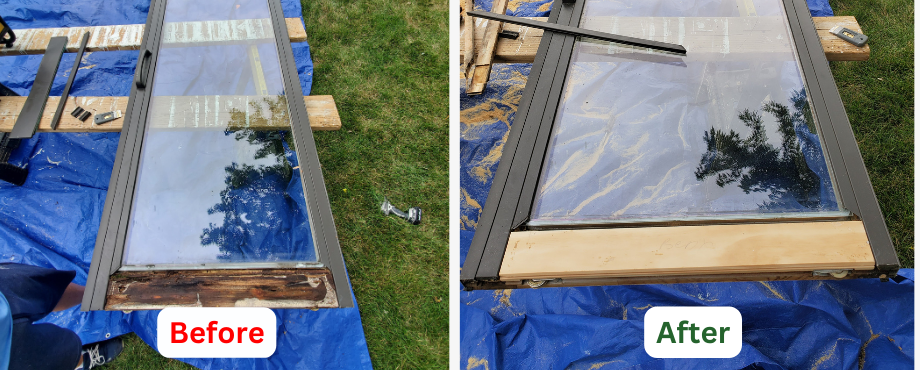
Then move inside. Inspect the weatherstripping around each operable window; it should be firm and intact so it forms a tight seal when the window closes. Weatherstripping that’s flattened, torn, or brittle no longer does its job. While you’re there, look for cracks in the glass, frame, and sash, and check the windowsill for soft or rotted wood. Rot around the sill or frame almost always means air and water are getting in.
2. Try the Paper Test
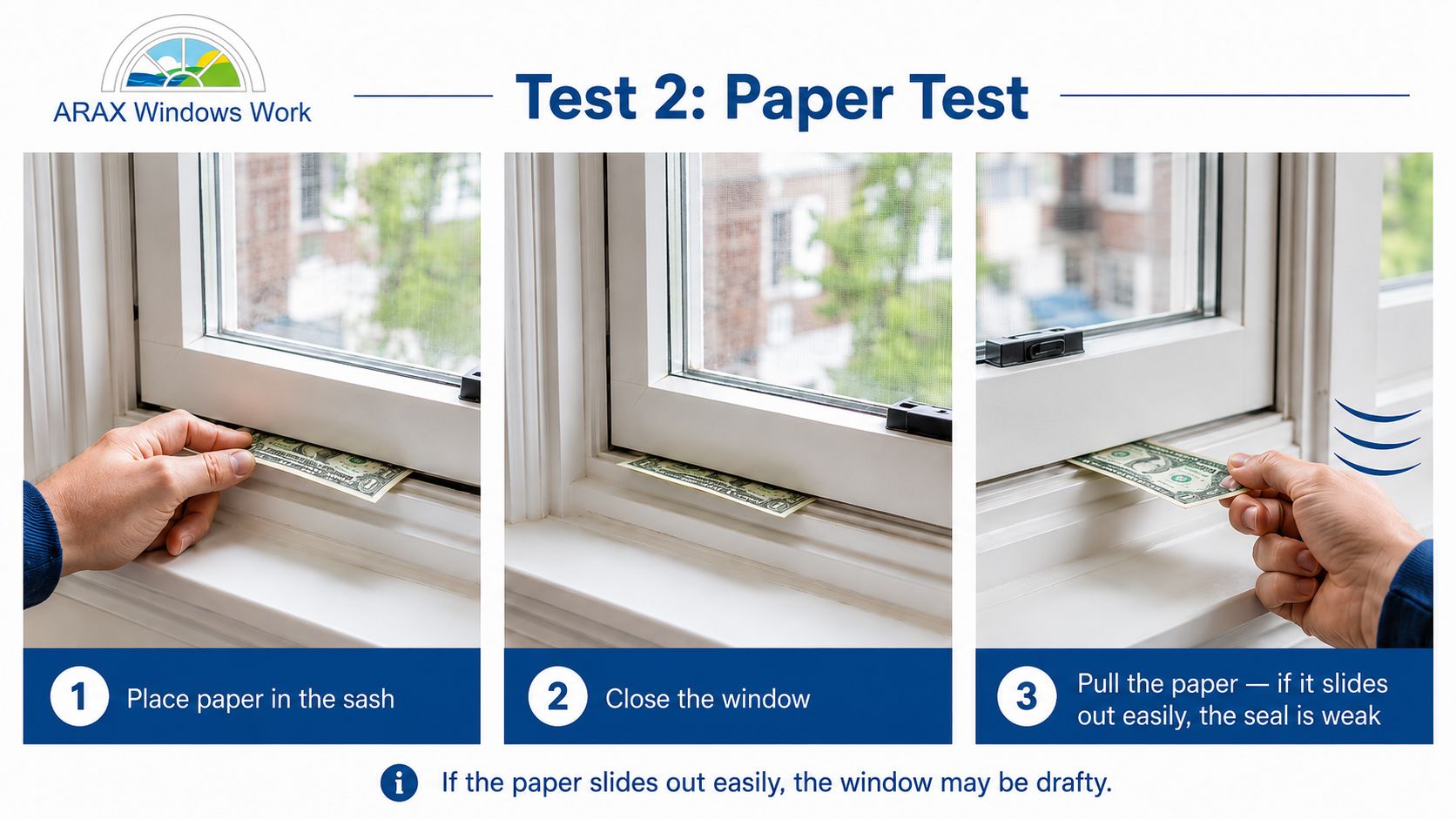
This one takes about ten seconds per window. Open the window, place a sheet of paper (a dollar bill works too) across the sill or between the sash and the frame, and close the window on it. Now pull the paper out.
If it slides out easily without tearing or catching, the window isn’t closing tightly, and air can pass through that same gap. Repeat the test at a few spots along the sash. A window that fails the paper test usually needs new weatherstripping, a hardware adjustment, or sash repair so it sits properly when closed.
3. Feel for Moving Air
Pick a windy day, or a cold day with a big temperature difference between inside and outside. Close all your windows and doors, then hold your hand a few inches from the edges of each window frame. Dampen your hand slightly first, since wet skin picks up moving air more easily than dry skin.
To make the test more sensitive, shut off combustion appliances like your furnace and water heater, then run your bathroom and kitchen exhaust fans. This pulls air out of the house and draws outside air in through any gaps, making leaks easier to feel.
4. Use the Candle or Incense Test
For leaks too small to feel by hand, smoke works better. Light a candle or an incense stick and pass it slowly around the perimeter of the window, a few inches from the edges of the frame and sash.
Watch the flame or the smoke trail. If it flickers, wavers, or gets blown sideways at any point, air is moving through a gap at that spot. Mark the location with painter’s tape so you can find it again. Keep the flame away from curtains and blinds while you test.
5. Check Temperatures with an Infrared Thermometer
If you want hard numbers instead of a hand test, an inexpensive infrared thermometer will find leaks without any guesswork. On a cold day, point it at the wall a few feet from the window to get a baseline reading, then scan slowly across the frame, sash edges, and sill.
Spots that read noticeably colder than the surrounding wall are letting outside air in. This test is especially useful for finding leaks behind trim or at the top of tall windows, where you can’t easily reach by hand. That’s a common blind spot in the two-story homes we inspect throughout the northwest suburbs.
What to Do If Your Windows Fail These Tests
A failed test doesn’t mean you need new windows. In most cases the window itself is fine, and the problem is a worn part: failed caulk, flattened weatherstripping, a loose sash, aging hardware, or a section of rotted wood. All of these can be repaired for far less than the cost of replacement, often up to 75% less.
Once you know where the drafts are coming from, our guide on how to reduce drafts from your windows covers the fixes in more detail, including when weatherstripping, caulk, or window film is the right call versus when replacement makes more sense.
Call Arax Windows Work for Window Repair Near Chicago
If your windows failed one or more of these tests, Arax Windows Work can fix the problem without replacing the whole window. Our window repair services cover rotted sills, sashes, and frames, worn weatherstripping and hardware, and glass repair and replacement for single, double, and triple pane windows. We repair most major brands, including Pella, Andersen, and Marvin, and we serve homes and businesses throughout the Chicago suburbs.
Call us at (815) 230-1890 or contact us online for a free estimate.

Drafty Windows FAQs
How can I tell which of my windows is drafty?
Start with a visual inspection of the caulk, weatherstripping, and wood, then try the paper test: close the window on a sheet of paper and see if it pulls out easily. For smaller leaks, pass a lit candle or incense stick around the window frame and watch for the flame or smoke to waver. An infrared thermometer can pinpoint cold spots around the frame with the least guesswork.
What is the best day to test for window drafts?
Test on a windy day or a day with a large temperature difference between inside and outside, since drafts are strongest and easiest to detect under these conditions. Running your kitchen and bathroom exhaust fans with everything closed also pulls outside air in through gaps, making leaks easier to find.
Can a drafty window really raise my energy bill?
Yes. The U.S. Department of Energy reports that heat gain and loss through windows accounts for 25 to 30 percent of a home’s heating and cooling energy use, and sealing those leaks can lower annual energy costs by 5 to 30 percent. A single leaky window is often enough to explain why one room never feels right or why a furnace runs longer than it should.
Do drafty windows need to be replaced?
Usually not. Most drafts come from worn parts such as failed caulk, flattened weatherstripping, loose sashes, or rotted wood around the sill or frame, and all of these can be repaired. Window repair can cost up to 75% less than full replacement while preserving the original look of your home.
Is there a tool to detect drafts?
Yes, an infrared thermometer is the easiest tool for detecting window drafts. It reads surface temperature so you can compare the window frame and sash against the surrounding wall and immediately spot the cold points where air is leaking through. Thermal imaging cameras work the same way but scan the whole window at once, which is useful if you’re checking several windows in one session. A smoke pencil or a stick of incense is a low-cost alternative that reveals air movement too faint to feel by hand. For most homeowners, an infrared thermometer offers the best balance of accuracy, cost, and ease of use.
Can I fix drafty windows myself?
Yes, most drafty windows can be fixed yourself. Worn weatherstripping, cracked caulk, and small gaps at the sill are simple DIY repairs that take under an hour per window with basic tools from a hardware store. Window insulation film and draft stoppers are also easy seasonal fixes. Call a professional if the draft comes from a broken glass seal, a warped or rotted frame, or a sash that no longer closes squarely, since patching those problems instead of repairing them properly usually makes them worse.
Who repairs drafty windows near Chicago?
Arax Windows Work provides window repair services throughout the Chicago suburbs, including sash, sill, and frame repair, weatherstripping and hardware replacement, and glass repair for single, double, and triple pane windows. Call (815) 230-1890 for a free estimate.